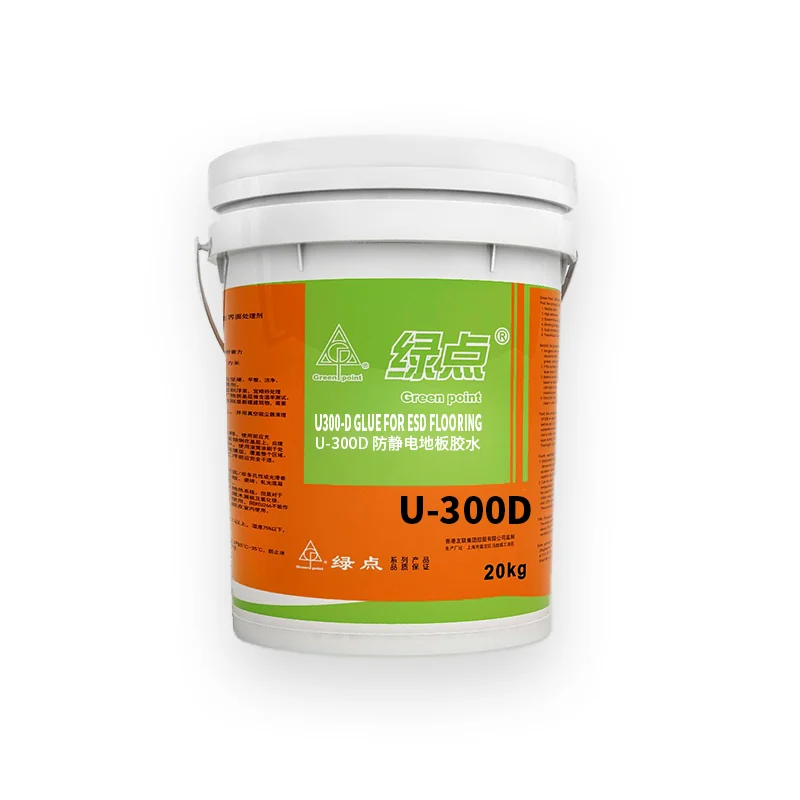
U300D conductive adhesive for ESD flooring
A solvent-free, plasticiser-free conductive adhesive that carries charge from the vinyl surface to the copper tape and the building earth.
Where it is used
- Static-dissipative and conductive vinyl sheet or tile.
- Data centres, electronics assembly, operating theatres, explosive-risk areas.
- Systems earthed through copper tape laid in the adhesive bed.
Not intended for
- General-purpose bonding — the conductive filler is only justified where earthing is required.
- Installations where the earth path is not designed and tested as part of the system.
| Type | Solvent-free, plasticiser-free conductive adhesive with curing and filling fillers |
|---|---|
| Body resistance | ≤ 3 × 10⁵ Ω (JC/T 550-2019, antistatic grade) |
| Colour | Milky white to light yellow |
| Viscosity | 40,000–55,000 mPa·s |
| Density | 1,000 g/L |
| pH | 7.4 |
| Tack time | 10–15 min |
| Open time | 10–30 min |
| Coverage | 200–250 g/m² (20 L ≈ 80–100 m²) |
| Trowel | A2 or B3 notched trowel |
| Substrate moisture | ≤ 4% |
| Ambient conditions | 20–25 °C / 48–55% RH; do not install below 5 °C |
Typical values, not a specification. Batch values are confirmed on the certificate of analysis.
How to run it
- Design the earth path first: copper tape layout determines whether the system works.
- Apply 200–250 g/m² with an A2 or B3 notched trowel — coverage is a specification, not a guideline.
- Lay the vinyl into wet adhesive within the open time; do not allow the film to skin.
- Test resistance after cure against the project specification, not just against the product limit.
Questions we get asked
Why does ESD flooring need a conductive adhesive?
The adhesive conducts charge from the vinyl surface down to the copper tape and the building earth. A standard adhesive breaks that path.
How is conductivity specified?
As body resistance ≤ 3 × 10⁵ Ω to JC/T 550-2019, antistatic grade. This is a material value, not the finished-floor resistance.
What coverage should be used?
200–250 g/m². Under-application is the most common cause of a failed earthing test.
Which trowel?
A2 or B3 notched trowel.
 U350
 GP166 / GP266
Need the datasheet for U300D?
Tell us the covering and the substrate, and we send the matching sheet with the sample.